1 in 5
organizations say they have a mature governance model for agentic AI; about four in five do not.
3,235 business and IT leaders in 24 countries. Deloitte, State of AI in the Enterprise, April 2026.
The goal is for them to deliver concrete value to the business while keeping control over what the AI does.
Principal Knowledge Architect & AI Engineer. Based in the US; engagements in the US, Europe and Brazil, in English, French or Portuguese.

“The pilot works; production never comes.”
“The answer changes from one run to the next, and nobody can prove where a conclusion came from.”
“Legal and compliance won't sign off, and we don't have people who know how to do this.”
1 in 5
organizations say they have a mature governance model for agentic AI; about four in five do not.
3,235 business and IT leaders in 24 countries. Deloitte, State of AI in the Enterprise, April 2026.
+380%
demand for AI regulation expertise; 48% of projects combine AI governance with data governance.
Malt platform perimeter, not a market estimate. Malt Tech Trends 2026.
53%
of companies already using AI cite lack of expertise as a barrier; 43%, data protection; 42%, legal clarity; 33%, cost.
France, companies with 10 or more employees, excluding banks and insurers. INSEE, Insee Première no. 2120, July 2026.
6% to 18%
share of French companies using AI, from 2023 to 2025; 58% among the large companies in the survey.
Same survey. INSEE, Insee Première no. 2120, July 2026.
These numbers give the general context. The conversation with each company starts before them: with the difficulties it has run into itself, in the words of the people who ran into them. The answer comes after, and depends on the case.
An AI agent declines a payment in an online store. Four people ask four questions about the same decision.
Auditable
Where did this decision come from? Which data, which rule, which model version, who validated it?
Reproducible
Same payment, same data: same answer? Even if the vendor updated the model in the meantime?
Verifiable
Does the refusal follow the contract and the anti-fraud policy in force that day, and can that be checked without asking the model?
Explainable
Why the refusal? "Risk score" is not an answer; the rule that tipped it is.
It is the same decision, and four different needs. A flow that answers all four is what I call governable AI.
I have always worked on both sides.
As a consultant, inside large organizations, on critical systems: payments, public health, professional certification, retail, for France's Groupe Casino in Brazil, Walmart, Brazil's Ministry of Health and FIRJAN. On most of those projects I was the principal engineer or the one responsible for the architecture.
And as a founder and CTO, with a software architecture and engineering consultancy and three startups. The latest, since 2024, is UBLE, an AI company for commerce and payments, where I am CTO.
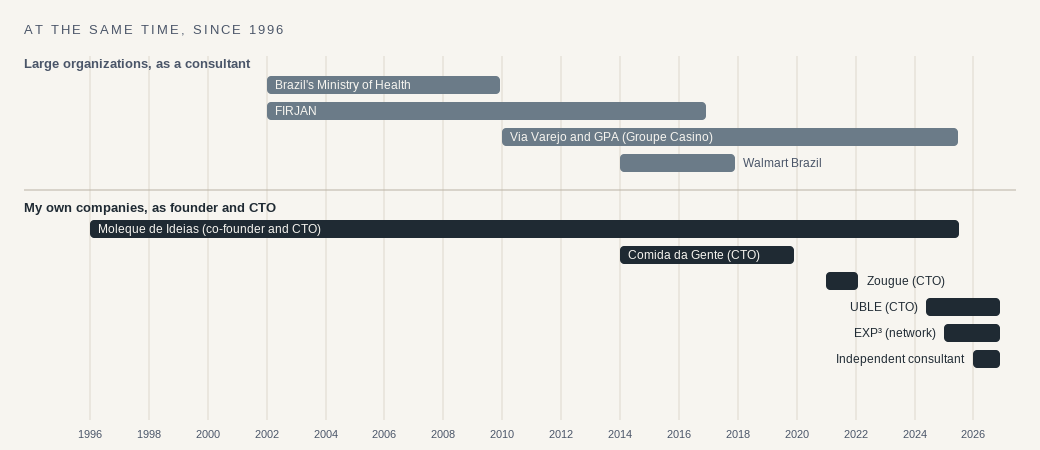
I know the constraints and the stakes of large organizations well. And I know what it means to have to deliver concrete results fast, with a small team and a limited budget. I try to hold the two together: move fast, with something that will last. With AI, that same tension is back: the speed of adoption on one side, the demands of production on the other.
The track record, year by yearFor close to thirty years I have held a fairly simple conviction.
Making business knowledge explicit helps keep systems running and lets them evolve. In my practice I used ontologies to define the concepts and their relations, and I built declarative languages to describe rules and flows formally: those definitions could then be handled as data, versioned, and changed over time. It was, first of all, a personal engineering choice. In payments, health and certification it proved particularly useful.
Today I draw on that experience to give AI systems an explicit frame. Business knowledge formalized with a date, an owner and a version, and a deterministic layer that decides what the model may do: ontology and semantic layer in production; rules out of the model's reach; knowledge graph, RAG and GraphRAG; a bitemporal record that keeps what was true and when it became known. The model is one component of the system. That defines the space the model operates in, before it and not after.
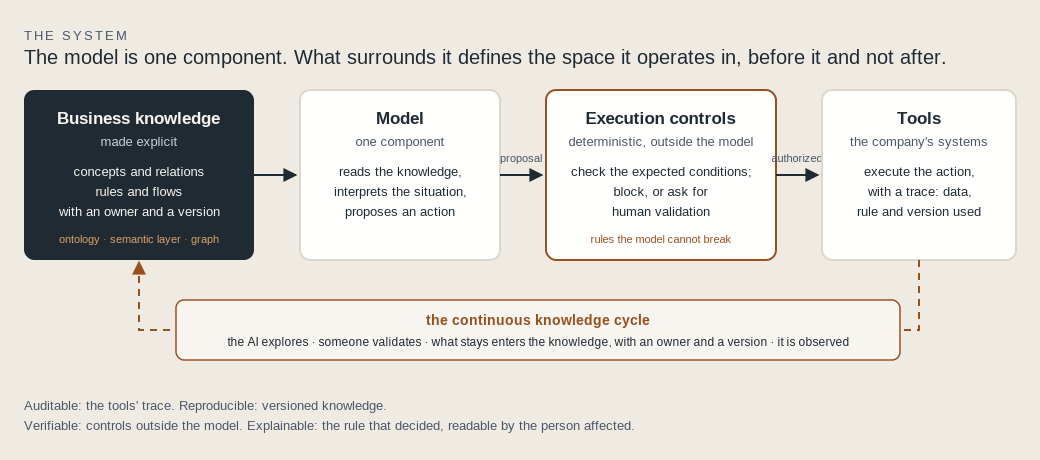
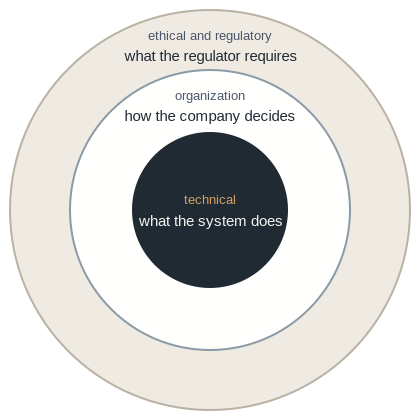
What is above is the technical plane. There are two more, and both come in with the AI whether the project wants them or not.
The organizational plane: the AI has to fit the way your company works and decides. It enters your organization, not only your architecture.
The ethical and regulatory plane: it has to fit the rules of your sector and the ones society is still writing.
That is why I founded EXP³ as a network: a community of AI specialists across sectors, between Brazil, the United States and Europe, because AI changes too many aspects of work to fit in a single specialty.
I diagnose, I design the architecture, and I write code. On an AI system that already exists or on a new one.
How it usually starts: one day on one of your flows, looking at the business and at governability; or a diagnostic of a few days; or training with the team's own flows in the room.
Diagnosis
Of the business: is the flow well placed, given the value it delivers and the risk it carries? Of governability: what can be demonstrated about it, on the four questions. I start from the flow as it is today, described by the people who run it; no diagram needed.
Architecture
I design the system around the model: ontology and semantic layer, rules out of the model's reach, knowledge graph, RAG and GraphRAG, bitemporal record, execution controls.
Hands-on code
I build what I designed, or fix what already exists: the deterministic layer, the agents, the integration with what the company already runs. Hands on the code, inside the client's team or leading it.
Working alongside the team
I work alongside the team while the work happens and train the people who will maintain the system, so that the capability stays with the client.
Year of delivery: 2026
Creative memory on a knowledge graph: GraphRAG in production for comedy writers.
Year of delivery: 2026
Auditable analytical intelligence: a neuro-symbolic system for media operations across three countries.
Pick a time. When booking, two questions: what the difficulty is, in your own words, and one flow as it is today, in broad strokes. I come to the conversation having read both.
AI changes a company at three levels: what the system does, how the company decides, what the regulator requires. Which one is giving you trouble?